 Coingecko
Coingecko measures a coin’s price drop against its recorded all-time high
Coingecko measures a coin’s drop from its all-time high by dividing the price gap by the peak price. Multiply that ratio by 100 to express the drop as a percentage. Matching the asset and quote currency keeps the comparison meaningful; the ATH date adds historical context.
Current price, recorded peak, and elapsed time
Coingecko pairs a current market price with a recorded peak price, while the ATH date anchors that peak in time. The prices determine the size of the drop; the dates determine how long ago the peak occurred. A price chart supplies the path between observations, which an endpoint calculation alone cannot describe. The current coin price aggregates eligible trading-market prices. An exchange quote can differ from that aggregate, producing a different calculation even for the same asset. Matching the asset record and denomination keeps the inputs consistent.
A moving current quote can change the percentage while the recorded peak stays fixed. Saved readings describe the prices at their recorded observation times.
Does a large drop from ATH mean a coin is undervalued?
A large drop from ATH measures distance from a past peak and does not establish that the current price is undervalued. The historical high supplies a reference price, with no promise of future demand. The formula contains no measure of token rights, trading liquidity, or future supply. It can compare how far prices lie below their own peaks when the inputs match. Coins can share a drop percentage despite having different price histories and supply conditions.
How do you calculate a drop from ATH?
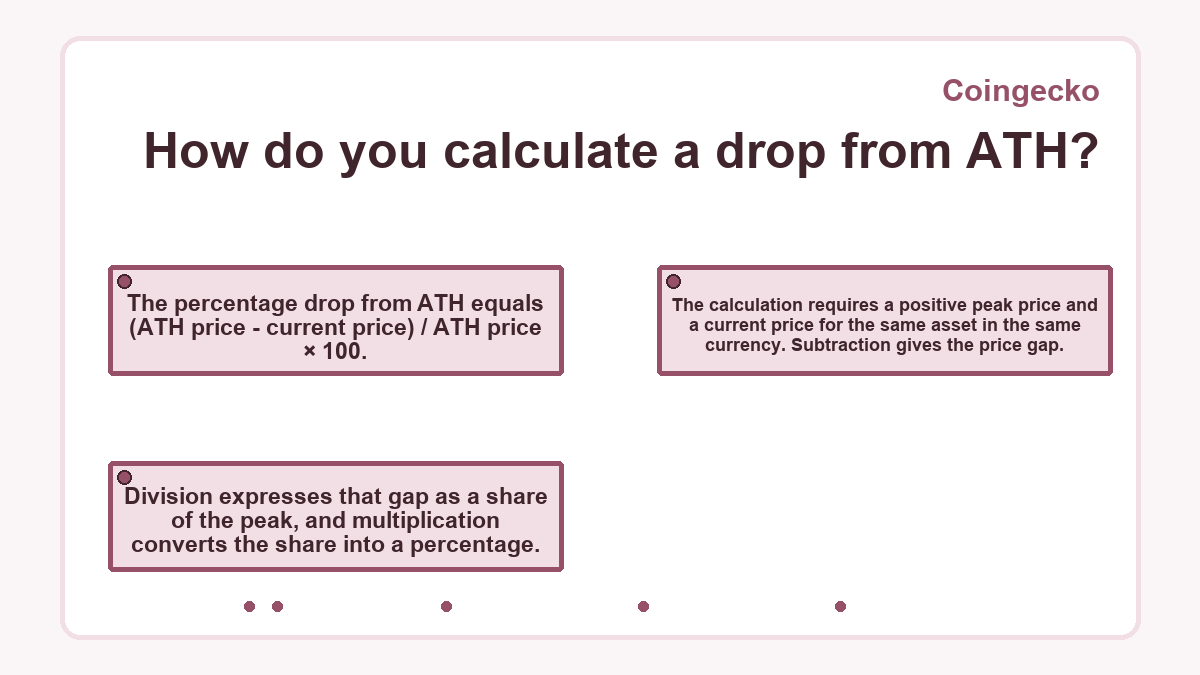
The percentage drop from ATH equals (ATH price - current price) / ATH price × 100. The calculation requires a positive peak price and a current price for the same asset in the same currency. Subtraction gives the price gap. Division expresses that gap as a share of the peak, and multiplication converts the share into a percentage.
Hypothetical prices and their percentage gap
All prices in this example are hypothetical USD quotes for the same coin. The recorded ATH is USD 13.68, and the current price is USD 8.208. The price gap is USD 5.472. Dividing 5.472 by 13.68 gives 0.4; multiplying by 100 gives a 40% drop.
The current price also equals 60% of the recorded peak: 8.208 / 13.68 = 0.6. Subtracting that fraction from 1 and multiplying by 100 produces the same 40% drop. This alternative expression checks the arithmetic independently of the subtraction-first calculation. Both expressions use the same price inputs. Their agreement confirms the calculated price relationship; it cannot establish the accuracy of the quotes or predict a future return to the peak.
A current quote above the saved peak
An alternative current price of USD 14.928 would exceed the saved ATH of USD 13.68. The drop formula would then return a negative value. That value describes a rise above the saved baseline, which can no longer be the up-to-date maximum if both observations belong to the same price series. Before reporting a drop from the latest ATH, recheck the peak record, asset, currency, and observation timing.
Confirming a new peak changes both the gap and denominator. The comparison then measures distance from that record, replacing the saved baseline.
Why can ATH drops differ across quote currencies?
An ATH drop can differ across quote currencies because the current price and historical peak belong to each currency’s own price series. Coingecko’s API records ATH prices by quote currency. Exchange rates can change between the peak and current observation. A historical peak converted at today’s rate may differ from the high in the target currency’s own history. A currency-specific high can also occur on a different date. The percentage needs matched price inputs, even though the final ratio has no currency unit.
The gain needed to reach the previous peak
Recovery uses the current price as its denominator, so the gain required to reach the peak exceeds the percentage drop when the current price is positive and below the peak.
Recovery from the current price
With H representing the peak and C representing a current price that is positive and below the peak, the required gain is ( H - C ) / C × 100. Below the ATH, the price gap represents a larger share of the lower current value. As the current price falls, the gain needed to reach an unchanged peak increases. Equal monetary moves in opposite directions can have unequal percentages because their starting values differ.
Drawdown and the zero-price boundary
A fall from a reference high is commonly called a drawdown. The ATH comparison measures the distance from the all-time record at the current observation. At a zero current price, the percentage recovery calculation divides by zero and is undefined. The ATH-drop formula reaches 100% if the peak remains positive.
Peak dates and valuation context
The ATH date locates the peak in time; circulating supply places that unit price within a separate market-cap calculation.
Elapsed time since the high
Coingecko calculates time since ATH as the difference between the current date and the ATH date. This measures the age of a recorded high. It gives no expected date for a return to that price. Identical drops can refer to peaks from different periods. Comparing their ages therefore answers a separate question from comparing their price gaps.
Circulating supply and holdings
Market capitalization multiplies a coin’s price by its circulating supply. If circulation changes, a return to the old unit price implies a different market cap from the one at the peak. The historical peak price therefore cannot establish the historical market cap without the supply that applied then. This dependency belongs to valuation comparisons; the ATH drop itself requires only prices. Portfolio tracking adds another basis: personal profit or loss depends on purchase prices, quantities, and the price used to value the holding. A coin’s ATH percentage cannot describe every holder’s profit or loss.
Coingecko: quick answers
Does a positive 24-hour change conflict with a drop from ATH?
A coin can gain over 24 hours while remaining below its all-time high. The daily change compares the current price with the price a day earlier. The ATH comparison uses the historical peak as its baseline, so the two percentages describe different intervals.
Is the highest point in a short chart window necessarily the all-time high?
The highest point in a selected chart window may fall below the recorded all-time high. A limited window excludes earlier prices. Its local maximum answers a question about that period, while the ATH value identifies the peak in the asset’s recorded history for the relevant currency.
How much precision should an ATH calculation keep before rounding?
Keep the available input precision through the calculation and round the final percentage. Rounding the current price or peak first can change the last digits of the result. A calculation based on shortened display values can therefore differ slightly from one using more precise inputs.
When an ATH input is blank, should a spreadsheet substitute zero?
A spreadsheet should leave the percentage unset when the ATH input is blank, because substituting zero creates an invalid denominator and cannot establish whether the price is at a high, below it, or above an older reference value.
Which API fields belong together when calculating a drop from ATH?
The price inputs come from matching currency entries in market_data.current_price and market_data.ath within a coin-detail API response that includes market data. The corresponding market_data.ath_date identifies the peak’s timestamp. Choose the same currency key for those fields; combining different keys produces a comparison with incompatible units.
What does a negative ATH change percentage in an API response mean?
A negative ath_change_percentage value represents a current price below the recorded peak. This field expresses signed change relative to that peak. Its negative sign differs from the positive magnitude returned by the drop formula. Preserve that distinction when labeling an imported value as either change or drop.
Do fees change the drop from ATH shown for a coin?
Fees do not enter the ATH price-drop formula. They matter when calculating personal returns from purchases or sales, alongside purchase prices and transaction amounts. A public price comparison and a net portfolio return therefore describe different quantities, even when they concern the same coin.
What timestamp should accompany a saved ATH-drop percentage?
A saved percentage should carry the time of the current price observation, along with the ATH date and quote currency. In an API response, market_data.last_updated identifies the market data’s update time. The peak’s date cannot serve as the timestamp for the current quote, and a saved percentage describes its recorded inputs.
· last updated